
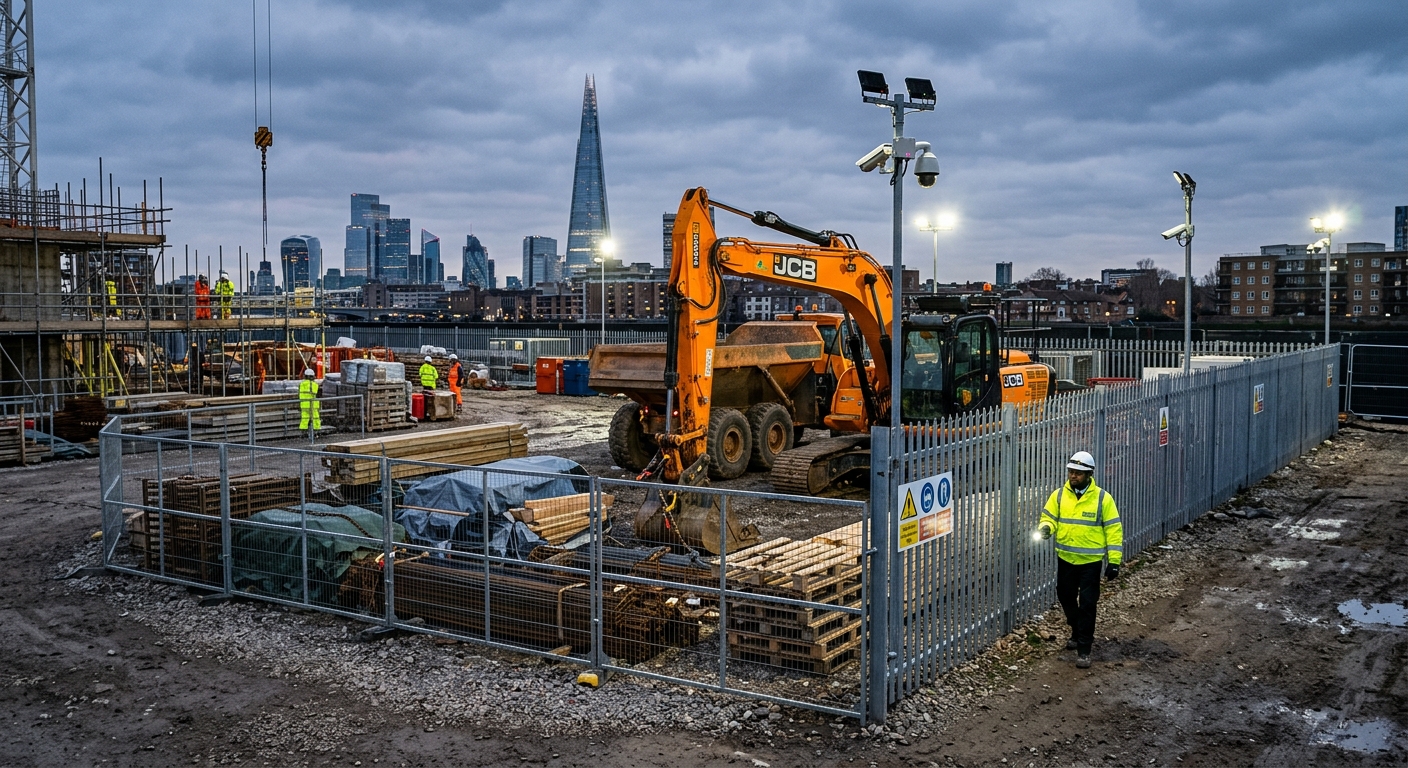
Construction sites can contain large quantities of valuable plant, materials, fuel, tools and equipment while also presenting serious hazards to anyone who enters without authorisation.
That makes site security more than a question of preventing theft.
A good construction security plan should help:
- prevent unauthorised access;
- protect members of the public;
- deter theft and vandalism;
- protect plant, tools, materials and fuel;
- control legitimate access;
- identify security incidents quickly;
- provide reliable evidence when something happens; and
- adapt as the project changes.
Why does construction site security matter?
Construction sites change constantly.
During mobilisation, the site may contain little more than welfare units, containers and temporary services.
Later it might contain:
- excavators and other plant;
- generators and battery systems;
- fuel;
- tools;
- cables;
- electrical equipment;
- construction materials;
- specialist equipment;
- installed assets; and
- temporary works.
A system that was adequate during the first week of mobilisation may no longer be appropriate once high-value equipment begins arriving.
Security therefore needs to be reviewed throughout the project.
Our construction site mobilisation checklist explains how security fits into the wider mobilisation process.
Security is also about preventing unauthorised access
Theft is only one reason to secure a construction site.
Unauthorised people entering the site may encounter:
- moving plant;
- excavations;
- temporary electrical systems;
- stored materials;
- work at height;
- incomplete structures;
- hazardous substances;
- fuel;
- machinery; and
- other construction hazards.
The Health and Safety Executive states that construction sites require measures to manage access across defined boundaries and steps to exclude unauthorised people.
The principal contractor should take reasonable steps to prevent unauthorised access to the construction site.
Start with the security risks
The appropriate security arrangement depends on the project.
A small urban refurbishment project may require a very different approach from a large remote infrastructure or renewable-energy site.
Consider:
- site location;
- surrounding land use;
- proximity to homes or schools;
- previous security incidents;
- public accessibility;
- number of entrances;
- perimeter length;
- visibility from surrounding roads;
- working hours;
- periods when the site is unattended;
- value of plant and materials;
- fuel storage;
- temporary power systems;
- installed equipment;
- delivery patterns; and
- how quickly assistance can reach the site.
It is to establish controls proportionate to the actual risks.
Use a layered approach
Construction site security is generally stronger when several controls work together.
For example:
- perimeter fencing discourages casual entry;
- controlled gates limit legitimate access points;
- lighting improves visibility;
- CCTV provides monitoring and evidence;
- guards provide a physical presence;
- plant immobilisation makes equipment harder to remove;
- secure storage protects smaller assets; and
- good records help identify what has happened if something goes missing.
A camera cannot physically stop someone entering.
A guard cannot continuously observe every part of a large site.
A fence may deter opportunistic access but can still be breached.
Layering controls reduces dependence on one measure.
1. Establish a secure perimeter
The perimeter is normally the first physical layer of site security.
Depending on the location and project, this may involve:
- temporary fencing;
- hoarding;
- permanent fencing;
- controlled gates;
- pedestrian access points; and
- additional protection around particularly sensitive areas.
Look for:
- damaged panels;
- gaps;
- unsecured gates;
- areas where fencing has moved;
- ground gaps;
- objects positioned next to fencing that could assist climbing; and
- places where work activities have temporarily compromised the boundary.
2. Control gates and access points
Every additional entrance can create another point that needs managing.
Where practical, minimise unnecessary access points and clearly define:
- main vehicle entrance;
- pedestrian entrance;
- delivery access;
- emergency access; and
- any restricted gates.
- who opens and closes gates;
- when gates should be locked;
- who holds keys or access credentials;
- how visitors are handled;
- how deliveries enter;
- what happens outside normal working hours; and
- how emergency access is maintained.
3. Know who should be on site
Effective security depends partly on distinguishing authorised people from unauthorised people.
A reliable attendance or access system can help establish:
- who entered;
- when they arrived;
- whether they remain on site;
- which contractor they work for; and
- when they left.
The method might involve:
- digital check-in;
- access control;
- a live register;
- security gate records;
- visitor records; or
- another suitable system.
4. Manage visitors and occasional access
Not everyone entering a construction site will be part of the regular workforce.
Visitors may include:
- clients;
- designers;
- surveyors;
- inspectors;
- delivery drivers;
- landowners;
- utility representatives; and
- other specialists.
- where visitors report;
- whether they require an induction;
- whether they need an escort;
- which areas they can access; and
- how their arrival and departure are recorded.
5. Protect plant and machinery
Construction plant can represent a significant concentration of value on site.
Security arrangements may include:
- removing keys when equipment is not in use;
- activating immobilisers or anti-theft systems;
- using physical security devices;
- parking plant in secure areas;
- blocking access routes where appropriate;
- using tracking systems;
- recording plant details; and
- checking security before the site closes.
Plant security should also consider how equipment could actually be removed from the site.
Controlling vehicle access and gates can therefore be just as important as securing the machine itself.
6. Maintain an asset register
If plant or equipment is stolen, accurate identification becomes important.
Maintain suitable records for significant assets, which may include:
- description;
- manufacturer;
- model;
- serial number;
- registration number;
- owner or hire company;
- project location;
- photographs;
- identifying marks; and
- relevant tracking information.
An asset register is useful for more than theft.
It can also support:
- hire management;
- project handover;
- maintenance;
- inspections;
- insurance; and
- demobilisation.
7. Secure tools and smaller equipment
Smaller items can be easier to remove than large plant.
Consider secure storage for:
- power tools;
- hand tools;
- test equipment;
- survey equipment;
- batteries;
- chargers;
- specialist installation tools; and
- other portable assets.
- secure containers;
- tool vaults;
- cabinets;
- locked stores; and
- controlled-access rooms.
8. Protect materials
Construction materials can also be attractive targets.
Depending on the project this could include:
- cable;
- copper;
- electrical equipment;
- fuel;
- batteries;
- metalwork;
- timber;
- specialist components; and
- packaged materials.
HSE guidance recommends keeping materials within the site perimeter, preferably in secure compounds or away from perimeter fencing where appropriate.
Think about when materials need to arrive as well.
Delivering high-value items months before they are required can increase both security exposure and storage problems.
9. Manage fuel security
Fuel theft can create direct cost, disruption and environmental risk.
Consider:
- tank location;
- locks;
- access controls;
- fuel monitoring;
- lighting;
- CCTV coverage;
- physical protection;
- delivery controls; and
- records of fuel use.
Security arrangements should therefore complement rather than interfere with those requirements.
10. Use lighting intelligently
Security lighting can improve visibility and act as part of a wider deterrent.
Potential locations include:
- gates;
- compounds;
- storage areas;
- fuel stores;
- plant parking;
- welfare areas;
- vulnerable sections of perimeter; and
- routes used by security personnel.
Consider:
- coverage;
- shadows;
- glare;
- neighbouring properties;
- environmental restrictions;
- temporary power capacity;
- photocells;
- timers; and
- interaction with CCTV.
11. Use CCTV as part of the system
Temporary CCTV and camera systems are common on construction projects.
They can help with:
- deterrence;
- remote monitoring;
- incident investigation;
- verifying alarms;
- observing gates and compounds; and
- maintaining evidence.
Useful coverage may include:
- entrances;
- vehicle gates;
- compounds;
- high-value storage;
- plant parking;
- fuel storage; and
- known vulnerable perimeter locations.
- who monitors the system;
- what triggers a response;
- how faults are reported;
- who can access recordings;
- how long recordings are retained; and
- what happens when an incident is detected.
Any CCTV deployment should also be operated in accordance with applicable data-protection requirements.
12. Decide whether security guards are required
Some projects may justify a physical security presence.
This might involve:
- static guards;
- gatehouse personnel;
- mobile patrols;
- dog handlers;
- night guards; or
- a combination of arrangements.
Where guards are used, define:
- required shift times;
- number of guards;
- patrol expectations;
- gate duties;
- incident response;
- handover arrangements;
- escalation contacts; and
- reporting requirements.
13. Verify guard attendance
Where security is purchased on an hourly or shift basis, the project should have a reliable record of the service actually provided.
For each shift it may be useful to know:
- guard;
- supplier;
- expected start;
- expected finish;
- actual arrival;
- actual departure;
- breaks where relevant;
- approved adjustments; and
- any exception.
For example, a guard may begin on Friday evening and remain part of a continuous security arrangement through the weekend.
The records need to represent what actually happened rather than forcing the shift into an unsuitable daily format.
14. Reconcile security attendance against invoices
Security costs can become difficult to verify if attendance records and supplier invoices are completely separate.
Before approving an invoice, the project may want to compare:
- contracted hours;
- planned shifts;
- actual attendance;
- approved additional hours;
- missed shifts;
- early arrivals;
- late departures;
- agreed rates; and
- invoice totals.
This does not mean every small timing difference automatically becomes a commercial dispute.
The purpose is to provide evidence so that the project manager can understand what was delivered and approve appropriate adjustments where necessary.
15. Manage exceptions rather than hiding them
Security attendance will not always be perfect.
Examples include:
- forgotten check-in;
- missed checkout;
- late arrival;
- early departure;
- unexpected additional guard;
- approved overtime;
- temporary increase in guard numbers; or
- a shift crossing several calendar days.
A useful process records:
- what happened;
- who corrected it;
- why it was corrected;
- when the correction was made; and
- who approved it where required.
16. Record security incidents
A security incident might involve:
- attempted unauthorised access;
- trespass;
- theft;
- attempted theft;
- vandalism;
- suspicious activity;
- perimeter damage;
- CCTV failure;
- gate damage;
- fuel theft; or
- an issue involving security personnel.
Useful information may include:
- date and time;
- location;
- people involved;
- description;
- immediate action;
- photographs;
- CCTV references;
- police or crime reference where applicable;
- follow-up actions; and
- responsible owner.
If an event identifies a wider project issue, it may also need to enter the construction action register.
17. Define the escalation process
Security personnel need to know what they are expected to do when something happens.
The escalation arrangement might identify:
- Site Manager;
- Project Manager;
- security supervisor;
- emergency services;
- client representative;
- landowner;
- facilities contact; and
- other relevant project contacts.
For example, a damaged fence discovered during a patrol is different from an active intrusion.
The escalation plan should be proportionate and understandable.
18. Manage keys and access credentials
Poor key control can undermine otherwise strong security.
The project may need to control keys for:
- gates;
- containers;
- plant;
- fuel stores;
- offices;
- electrical rooms;
- compounds; and
- installed assets.
- key identifier;
- what it opens;
- who holds it;
- when it was issued;
- when it was returned; and
- lost or replaced keys.
19. Consider weekends, holidays and shutdown periods
Security risk can change when normal construction activity stops.
Before weekends, public holidays or shutdown periods, consider:
- perimeter condition;
- gate security;
- plant immobilisation;
- fuel;
- temporary power;
- lighting;
- alarms;
- CCTV;
- guard cover;
- emergency contacts;
- weather exposure;
- high-value deliveries; and
- incomplete work that could attract unauthorised access.
Longer shutdowns may justify additional checks.
20. Review security after an incident
An incident should trigger more than simply replacing what was stolen or repairing the fence.
Ask:
- How was access gained?
- Was the perimeter adequate?
- Did CCTV capture the event?
- Was anyone monitoring it?
- Did an alarm operate?
- Was the response fast enough?
- Was plant properly secured?
- Were valuable materials unnecessarily exposed?
- Did the escalation process work?
- Does the security plan need changing?
21. Review security as construction progresses
A construction security plan should not remain static.
Review it when:
- site boundaries change;
- new access points open;
- compounds move;
- workforce numbers change;
- high-value equipment arrives;
- significant plant is mobilised;
- fuel storage changes;
- buildings become enclosed;
- electrical equipment is installed;
- commissioning begins;
- an incident occurs; or
- the project approaches demobilisation.
A practical construction site security checklist
A high-level security review might look like this:
| Security area | Check | | --- | --- | | Perimeter | Fencing or hoarding suitable and in good condition | | Gates | Access points controlled and locking arrangements defined | | Attendance | Reliable record of workers and visitors entering and leaving | | Visitors | Reporting, induction and escort arrangements established | | Plant | Keys removed and appropriate immobilisation/security used | | Asset register | Important plant and equipment identifiable and recorded | | Tools | Secure storage available for portable equipment | | Materials | High-value materials stored appropriately | | Fuel | Tanks and fuel arrangements protected | | Lighting | Vulnerable areas adequately covered | | CCTV | Cameras positioned, operational and response arrangements understood | | Guards | Required shifts, numbers and responsibilities defined | | Guard attendance | Actual attendance recorded against expected shifts | | Invoices | Security hours capable of being reconciled before approval | | Incidents | Security incidents recorded and escalated | | Keys | Keys and access credentials controlled | | Weekends | Out-of-hours arrangements confirmed | | Contacts | Security escalation contacts current | | Actions | Security defects and improvements assigned to owners | | Review | Security arrangements reviewed as the project changes |
This is not a universal security specification.
The controls needed should reflect the site's location, project stage, risks, contractual requirements and applicable legal obligations.
Keep security information connected
Security management can become fragmented surprisingly quickly.
The Project Manager may have:
- the security contract in one location;
- guard rosters in a spreadsheet;
- check-in records somewhere else;
- invoices arriving by email;
- CCTV information held separately;
- incident reports in the site diary;
- camera details in another register; and
- outstanding security actions in meeting minutes.
This is one of the problems SiteSafe+ Security Hub is designed to solve.
SiteSafe+ brings security information into the wider project-control environment.
Security Hub can provide project teams with visibility of areas such as:
- security guard rosters;
- actual guard attendance;
- expected and chargeable hours;
- attendance exceptions;
- project security rates;
- invoice evidence;
- security incidents;
- security suppliers; and
- camera assets.
It is to connect the operational evidence with the commercial and project-management information needed to manage the service.
Security should be evidence-based
Good construction security is not measured by how many cameras, guards or lights a project has.
The important questions are whether the controls match the risks and whether the project team can demonstrate that they are working.
That means knowing:
- who accessed the site;
- whether the perimeter is secure;
- what valuable assets are present;
- whether security systems are operational;
- whether guards attended as required;
- what incidents occurred;
- what actions remain outstanding; and
- whether the security service being invoiced reflects the service provided.