
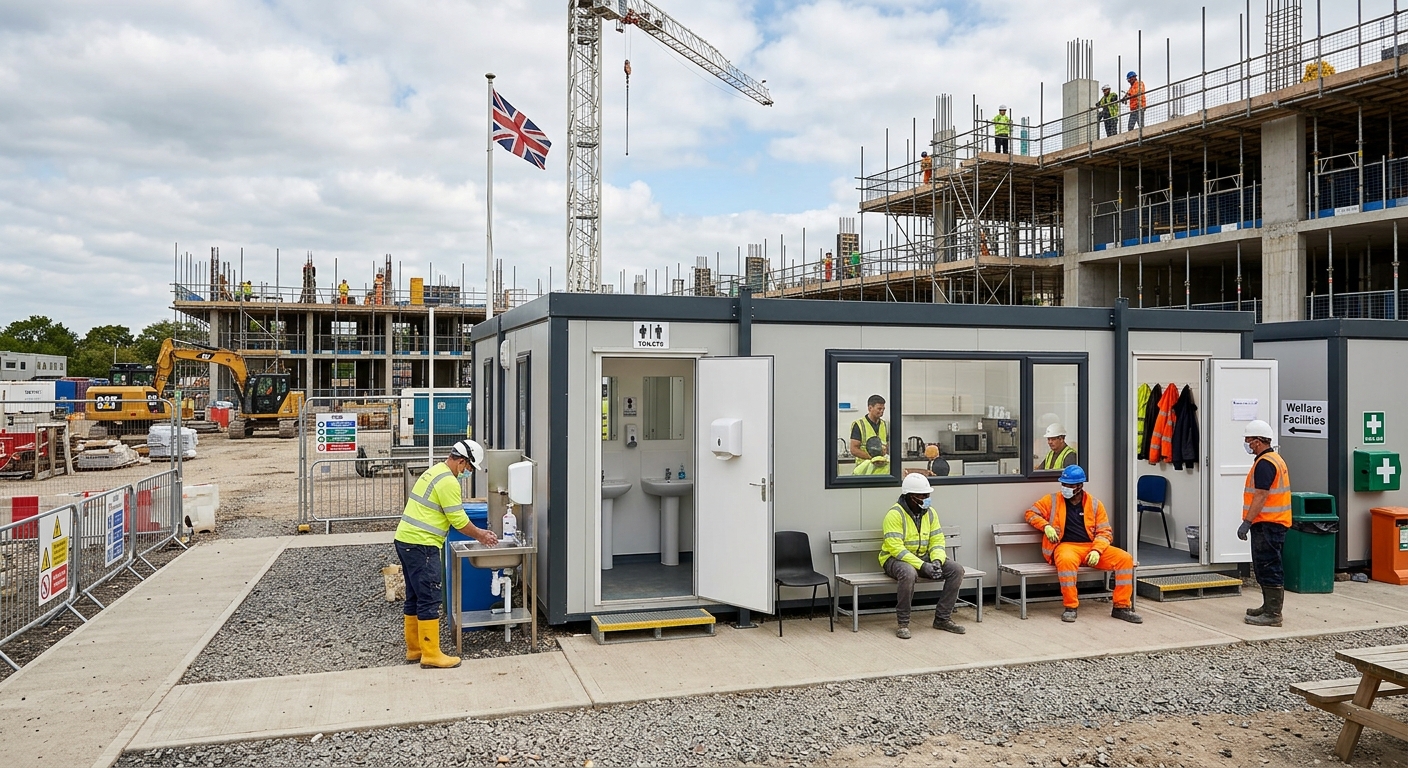
Construction workers must have access to suitable welfare facilities from the start of a project.
This is not an optional extra that can be added once the site is established.
Under the Construction (Design and Management) Regulations 2015 (CDM 2015), welfare arrangements need to be considered when the project is planned and appropriate facilities must be provided for people carrying out construction work.
At a practical level, construction site welfare will normally need to address:
- toilets;
- washing facilities;
- drinking water;
- changing facilities where required;
- storage for clothing and personal belongings;
- facilities for drying work clothing where required;
- rest facilities;
- somewhere suitable to eat and prepare food and drinks; and
- showers where the nature of the work or health risks make them necessary.
This guide provides a practical construction site welfare checklist based on CDM 2015 and current HSE guidance.
What welfare facilities are required on a construction site?
Schedule 2 of CDM 2015 sets out minimum welfare requirements for construction sites.
Depending on the project, workers may require:
- suitable and sufficient toilets;
- suitable and sufficient washing facilities;
- showers where required by the nature of the work or for health reasons;
- drinking water;
- changing rooms where workers have to wear special clothing and cannot reasonably change elsewhere;
- facilities for storing clothing;
- facilities for drying wet or damp work clothing where necessary; and
- rest facilities with appropriate seating and arrangements for preparing and eating meals.
- number of workers;
- proportion of men and women;
- type of construction work;
- hazardous substances involved;
- project duration;
- site size;
- location;
- distance workers need to travel to the facilities; and
- whether the workforce operates across several parts of a large site.
Workers need to be able to access suitable facilities when they need them.
Construction site welfare checklist
A basic welfare inspection should consider the following areas.
Toilets
- Are suitable and sufficient toilets available?
- Are they readily accessible?
- Are flushing toilets provided where reasonably practicable?
- Are toilets adequately ventilated and lit?
- Are they kept clean and orderly?
- Is toilet paper consistently available?
- Are suitable arrangements in place for men and women?
- Is sanitary waste disposal provided where required?
- Are portable toilets serviced frequently enough?
- Are additional facilities required for remote parts of the site?
Washing facilities
- Are washing facilities available close to toilets?
- Are washing facilities available close to changing areas where required?
- Is clean hot and cold, or warm, water provided?
- Is running water provided so far as reasonably practicable?
- Is soap or another suitable cleaning product available?
- Are towels or another suitable means of drying available?
- Are basins large enough for workers to wash properly?
- Are washing areas ventilated and lit?
- Are they kept clean?
- Are showers required because of the work or health risks?
Drinking water
- Is wholesome drinking water readily available?
- Is it clearly identified where necessary?
- Can workers access it easily?
- Are cups or another suitable drinking method available where required?
- Is stored or bottled water protected from contamination?
- Is the supply sufficient for the workforce?
Changing and clothing storage
- Do workers need to wear special clothing?
- Is a suitable changing area required?
- Can men and women change separately where necessary?
- Is seating provided?
- Can workers store clothing and personal belongings securely?
- Can work clothing be kept separate where contamination is a concern?
Drying facilities
- Is work clothing likely to become wet?
- Is there somewhere suitable to dry it?
- Are drying arrangements adequate for the size of the workforce?
- Can contaminated PPE or clothing be kept separate from everyday clothing where necessary?
Rest and eating facilities
- Is there a suitable rest area?
- Is there enough seating for the number of workers likely to use it at one time?
- Do seats have backs?
- Are sufficient tables provided?
- Can workers prepare and eat food appropriately?
- Is there a means of boiling water?
- Can food be heated where appropriate?
- Is the area adequately heated during cold weather?
- Is it appropriately ventilated during warmer weather?
- Is it clean and tidy?
- Is it free from stored plant, materials and equipment?
Maintenance
- Is somebody responsible for checking welfare facilities?
- Are toilets cleaned often enough?
- Are soap, towels and toilet paper replenished?
- Is waste removed?
- Are faults dealt with promptly?
- Are water and drainage systems working?
- Are welfare arrangements reviewed as the workforce grows?
- Are facilities relocated or expanded as the project changes?
Toilets on construction sites
Construction sites need suitable and sufficient sanitary conveniences at readily accessible locations.
HSE recommends flushing toilets connected to mains water and drainage systems where possible.
Where a mains connection is unavailable, alternatives can include toilets with their own water supply and drainage tanks.
Portable chemical toilets can also be used where more suitable arrangements are not reasonably practicable, particularly on temporary or smaller sites or during stages of a project when permanent connections are unavailable.
The important point is that a portable toilet is not automatically adequate simply because one has been delivered to site.
It still needs to be:
- suitable;
- accessible;
- ventilated;
- lit;
- maintained;
- cleaned; and
- serviced frequently enough for the number of people using it.
How many toilets does a construction site need?
CDM 2015 does not provide one simple worker-to-toilet ratio that applies to every construction project.
The number required depends on matters such as:
- workforce size;
- proportion of men and women;
- type of toilet;
- servicing arrangements;
- working hours; and
- site layout.
For portable chemical toilets, HSE also refers to BS guidance recommending one portable toilet for seven people working a 40-hour week where the toilets are serviced weekly.
That figure should not be treated as a universal rule.
If toilets receive heavy use or are emptied less effectively, more provision or more frequent servicing may be required.
On a large site, additional facilities may also be needed simply because workers should not have to travel unreasonable distances to reach a toilet.
Do men and women need separate toilets?
Appropriate arrangements must be provided for men and women.
Separate rooms containing toilets should generally be provided unless each toilet is in a separate room that can be secured from the inside.
HSE guidance also states that sanitary waste disposal should be provided in facilities used by female workers.
The workforce should be considered when the facilities are planned rather than waiting until somebody raises a complaint.
What washing facilities are required?
Suitable washing facilities are a basic construction welfare requirement.
They should normally be located near toilets and, where changing rooms are required, near those changing areas.
Washing facilities should include:
- clean hot and cold, or warm, water;
- running water so far as reasonably practicable;
- soap or another suitable means of cleaning;
- towels or another suitable means of drying;
- suitable ventilation; and
- suitable lighting.
HSE guidance specifically notes that workers should be able to wash their hands, face and forearms properly.
A tiny sink containing only cold water or hand sanitiser may not provide suitable washing arrangements.
Is hand sanitiser enough on a construction site?
Not normally as a replacement for suitable washing facilities.
Hand sanitiser can be useful in some circumstances, but construction workers may need to remove:
- dirt;
- dust;
- cement;
- oils;
- chemicals;
- biological contamination; or
- other substances from their skin.
The welfare arrangement needs to reflect the actual work being carried out.
When are showers required?
Not every construction project automatically needs showers.
However, Schedule 2 requires showers where they are necessary because of the nature of the work or for health reasons.
They may therefore be necessary where workers are exposed to particularly dirty or hazardous work.
Examples could include work involving contamination where washing only the hands and forearms would not provide adequate hygiene.
The requirement should be considered as part of the project's risk assessment and COSHH arrangements where relevant.
HSE specifically notes that additional welfare provision such as showers may be necessary to control exposure to substances such as cement, lead or micro-organisms.
Why are washing facilities a health control?
Welfare facilities are not simply about worker comfort.
They can form part of the control measures used to protect workers from occupational health risks.
Consider cement.
If workers handle wet cement and suitable washing facilities are unavailable, contamination can remain on the skin.
Likewise, where workers encounter hazardous dusts, lead, biological contaminants or other substances, suitable hygiene arrangements can help prevent contamination being:
- left on the skin;
- transferred to food;
- carried into rest areas;
- taken into vehicles; or
- taken home on clothing.
Should washing and eating areas be separate?
Workers should generally not be washing contaminated hands in the same area used for eating and drinking.
This becomes particularly important where workers may be exposed to hazardous substances.
HSE recommends separating washing arrangements from eating and rest areas where substances such as cement, lead or micro-organisms could create a contamination risk.
Good welfare design should make clean behaviour easy.
For example:
Work area
↓
Suitable washing facilities
↓
Clean rest and eating area
is a much better arrangement than expecting workers to walk through the canteen while covered in site contamination.
What drinking water must be provided?
Suitable drinking water must be available.
HSE guidance says drinking water should always be available, clearly identified and easy to access.
A mains supply should be used where possible.
Where bottled or stored water is used, it should be managed so that it does not become stale or contaminated.
Suitable cups should also be provided unless workers can drink directly from a fountain or another appropriate arrangement.
The amount of drinking water available should reflect the workforce and conditions.
Hot weather and physically demanding work can significantly increase demand.
Are changing rooms required on every construction site?
Not necessarily.
Changing facilities are required where workers need to wear special clothing for their work and cannot reasonably be expected to change elsewhere.
Where changing facilities are required, they should be suitable for the workforce.
Consider:
- privacy;
- separate arrangements for men and women where appropriate;
- seating;
- clothing storage;
- drying arrangements; and
- separation of contaminated clothing.
Do workers need lockers?
Workers need suitable arrangements for keeping clothing and personal belongings secure.
This does not necessarily mean every small project needs a large purpose-built locker room.
HSE notes that on smaller sites secure storage could potentially be provided in a site office or vehicle.
The arrangement should be proportionate while still providing appropriate security.
Where contaminated protective equipment or clothing is involved, it may also need to be kept separate from everyday clothing.
Do construction sites need drying rooms?
Workers need suitable facilities for drying work clothing where necessary.
This is particularly relevant on projects where workers are exposed to rain, water or wet working conditions.
Putting on wet clothing day after day is not an acceptable long-term welfare arrangement.
The required facility will depend on:
- number of workers;
- type of clothing;
- project conditions;
- available space; and
- how quickly items need to dry.
What should a construction site rest area contain?
Workers need somewhere suitable to rest and eat.
HSE guidance says rest areas should have:
- enough tables;
- enough seats for the number of people likely to use them at any one time;
- seats with backs;
- arrangements for preparing and eating food;
- a way to boil water;
- appropriate ventilation during warmer weather; and
- heating during colder weather.
It should not become an overflow storage area for:
- tools;
- materials;
- PPE;
- plant;
- fuel; or
- general site equipment.
Does a site need a microwave and kettle?
HSE guidance requires suitable arrangements that allow workers to prepare and eat meals and includes a means of boiling water.
The exact equipment used can vary.
On many sites, this is practically achieved with equipment such as:
- a kettle or water boiler;
- microwave;
- refrigerator where appropriate;
- tables; and
- suitable seating.
Electrical equipment used within welfare facilities should also form part of the site's electrical safety arrangements.
Do welfare facilities need heating?
Rest facilities need to provide a suitable environment for workers.
HSE guidance specifically identifies heating during cold weather and ventilation during warmer conditions.
This is particularly relevant on temporary construction sites where welfare cabins can become extremely cold in winter or excessively hot during summer.
Heating arrangements themselves should also be safe.
For example, suitable electric heating may avoid risks associated with poorly managed LPG heaters and carbon monoxide.
Can workers use a nearby café or public toilet?
Existing facilities can sometimes form part of the welfare arrangements, but this needs to be properly planned.
HSE states that facilities in places such as:
- local cafés;
- public toilets; or
- occupied buildings
However, the project needs to ensure that:
- there is proper agreement allowing workers to use them;
- they are available whenever workers are on site;
- they are sufficiently close;
- they are suitable for the work and workforce; and
- cleaning and consumable arrangements are appropriate where relevant.
The accessibility and suitability of the facilities need to be considered.
What about small construction sites?
Small sites still require welfare facilities.
The scale of the facilities may be different, but the basic welfare needs do not disappear because only a few people are working on the project.
A small project may use:
- an existing toilet;
- suitable washing facilities within an occupied building;
- a small mobile welfare unit;
- a portable toilet with appropriate washing arrangements; or
- another proportionate solution.
What about short-duration work?
Short-duration work still requires welfare planning.
This can be particularly challenging for activities such as:
- road works;
- utility work;
- repairs;
- maintenance;
- mobile works; and
- remote construction activities.
- mobile welfare units;
- central compounds;
- satellite facilities;
- agreed use of suitable existing facilities; or
- other proportionate arrangements.
It does not remove the need to provide it.
What about large construction sites?
Large sites may need more than one welfare location.
Consider how long it takes a worker at the furthest point of the project to reach:
- a toilet;
- washing facilities;
- drinking water; or
- a rest area.
Additional toilets and washing facilities may therefore be needed in remote areas of a large project.
A single high-quality welfare compound is of limited practical value if some workers need a lengthy journey to use it.
When should welfare facilities be provided?
Welfare facilities should be available from the start of construction work.
They should not arrive several weeks after the workforce.
This needs to be considered during project planning and mobilisation.
Before work starts, establish:
- what facilities are required;
- where they will be positioned;
- water supply;
- drainage;
- electricity;
- cleaning arrangements;
- waste arrangements;
- servicing;
- access for maintenance vehicles; and
- how provision will change as the workforce grows.
Should welfare facilities change during the project?
Potentially, yes.
Construction projects evolve.
The initial workforce might consist of ten people, while peak construction could involve 150.
Likewise, a welfare compound that is conveniently located during groundworks may become difficult to access during later phases.
Review welfare when there are significant changes to:
- workforce numbers;
- working hours;
- project layout;
- work locations;
- male/female workforce balance;
- hazardous activities;
- project phases; or
- site access.
- expanded;
- relocated;
- supplemented; or
- serviced more frequently.
Who should inspect construction welfare facilities?
The project should have a clear arrangement for routine welfare checks.
Depending on the site, this may be undertaken by:
- site management;
- a designated site supervisor;
- facilities personnel;
- health and safety staff; or
- another appointed person.
A welfare inspection could check:
- cleanliness;
- water supply;
- hot water;
- toilet paper;
- soap;
- hand drying;
- lighting;
- heating;
- ventilation;
- drinking water;
- waste;
- seating;
- food preparation facilities;
- clothing storage;
- drying facilities; and
- damage or defects.
HSE notes that daily toilet cleaning may not always be sufficient, particularly on muddy or heavily used sites.
Keep records of welfare inspections
A simple welfare inspection record can help demonstrate that facilities are being monitored rather than only addressed when somebody complains.
A record might include:
- project;
- inspection date;
- person completing the inspection;
- facilities checked;
- defects identified;
- corrective action;
- responsible person;
- target date; and
- close-out status.
The objective is not paperwork for its own sake.
The record should help make sure defects are actually corrected.
Common construction welfare failures
No hot or warm water
Cold water or hand sanitiser alone may not provide suitable washing arrangements for construction work.
Too few toilets
Provision needs to reflect the number of workers and how frequently toilets are serviced.
Dirty toilets
Facilities need to be maintained and cleaned often enough for the conditions.
No soap or towels
A sink is not a complete washing facility if workers cannot properly clean and dry their hands.
No suitable rest area
Workers need somewhere suitable to rest and eat.
Using the canteen for storage
Rest areas should not become storage rooms for tools, materials and equipment.
No drying facilities
Wet work clothing needs suitable drying arrangements where required.
Facilities too far away
Large projects may need additional welfare facilities in remote work areas.
Welfare arriving after work starts
Facilities need to be available from the start.
Not increasing facilities as the workforce grows
Welfare arrangements suitable for the first ten workers may be inadequate when the project reaches peak workforce.
Ignoring hazardous work
Dirty or hazardous work may require enhanced washing or shower facilities.
Construction site welfare inspection checklist
A routine inspection could use the following checklist.
Toilets
- [ ] Suitable number available
- [ ] Readily accessible
- [ ] Clean
- [ ] Properly lit
- [ ] Properly ventilated
- [ ] Toilet paper available
- [ ] Sanitary disposal available where required
- [ ] Locks working
- [ ] Servicing adequate
Washing
- [ ] Hot and cold, or warm, water available
- [ ] Running water where reasonably practicable
- [ ] Soap available
- [ ] Towels or hand drying available
- [ ] Basins suitable for hands, face and forearms
- [ ] Facilities clean
- [ ] Lighting adequate
- [ ] Ventilation adequate
- [ ] Showers provided where required
Drinking water
- [ ] Supply available
- [ ] Clearly identified where necessary
- [ ] Easy to access
- [ ] Supply clean and protected
- [ ] Cups available where required
Changing and clothing
- [ ] Changing facilities available where required
- [ ] Appropriate privacy arrangements
- [ ] Secure storage available
- [ ] Seating provided
- [ ] Wet clothing can be dried
- [ ] Contaminated clothing can be separated where necessary
Rest and eating
- [ ] Suitable rest area
- [ ] Enough tables
- [ ] Enough seats
- [ ] Seats have backs
- [ ] Means of boiling water
- [ ] Food can be prepared/eaten appropriately
- [ ] Heating adequate
- [ ] Ventilation adequate
- [ ] Area clean
- [ ] No inappropriate storage
Management
- [ ] Cleaning arrangements defined
- [ ] Consumables regularly replenished
- [ ] Waste removed
- [ ] Defects recorded
- [ ] Actions assigned
- [ ] Actions closed
- [ ] Workforce numbers reviewed
- [ ] Facilities remain suitably located
How SiteSafe can help manage welfare compliance
Providing the physical welfare facilities is only part of the job.
Site teams also need a practical way to check that arrangements remain suitable as the project changes and to record problems when they are identified.
SiteSafe can support that management process through digital forms, workforce records, site reporting and project compliance information.
Create a digital welfare inspection
A welfare checklist can be converted into a digital site form.
Instead of relying on an inspection sheet sitting in a folder, the site team can record checks against items such as:
- toilets;
- washing facilities;
- hot water;
- soap and drying;
- drinking water;
- changing facilities;
- drying arrangements;
- rest areas;
- heating;
- cleaning; and
- consumables.
Record defects when they are found
A welfare inspection is useful only if problems lead to action.
If an inspection identifies:
No hot water
or
Portable toilet requires servicing
or
Drying room heater not working
the issue can be captured as part of the site record rather than relying on somebody remembering to deal with it later.
This helps turn the welfare checklist into an active management process.
Keep timestamped inspection evidence
Digital records can provide a clearer audit trail of when welfare was checked and what was identified.
That can be useful during:
- internal reviews;
- client inspections;
- health and safety audits;
- project meetings; and
- regulatory inspections.
Monitor welfare against workforce numbers
The suitability of welfare provision depends partly on how many people are using it.
SiteSafe's QR site check-in supports live workforce attendance.
That workforce information can help site management recognise when the project has grown beyond the welfare arrangements originally provided.
For example, facilities established for a small mobilisation team may need reviewing once multiple subcontractors and a larger workforce arrive.
Include welfare in wider CDM compliance
Welfare should not be managed as an isolated site-office issue.
It forms part of the project's wider CDM arrangements.
SiteSafe's CDM compliance tools can help project teams manage compliance requirements alongside other site processes.
SiteSafe can also bring together:
- site inductions;
- toolbox talks;
- RAMS;
- permits to work;
- digital forms; and
- workforce attendance.
Build welfare checks into routine site management
The strongest approach is not to wait for welfare conditions to deteriorate.
Make welfare inspection part of normal site management.
For example:
Worker numbers change
↓
Welfare provision reviewed
↓
Digital welfare inspection completed
↓
Problems identified
↓
Actions assigned and corrected
↓
Record retained with project compliance information
That makes welfare an ongoing management process rather than a one-off mobilisation exercise.
Explore SiteSafe digital forms to see how site inspections and compliance checks can be managed digitally.
Welfare needs to be suitable from day one
Construction welfare is a basic legal requirement and an important part of protecting worker health.
The practical test is not whether the project has a welfare cabin.
It is whether workers actually have suitable access to:
toilets
washing facilities
drinking water
changing and drying facilities where required
and
a clean place to rest and eat.
Those arrangements need to be appropriate for the size and nature of the project, available from the start and maintained as the site changes.
A simple welfare checklist, completed regularly and followed by prompt corrective action, can help prevent basic facilities from becoming a persistent compliance problem.