
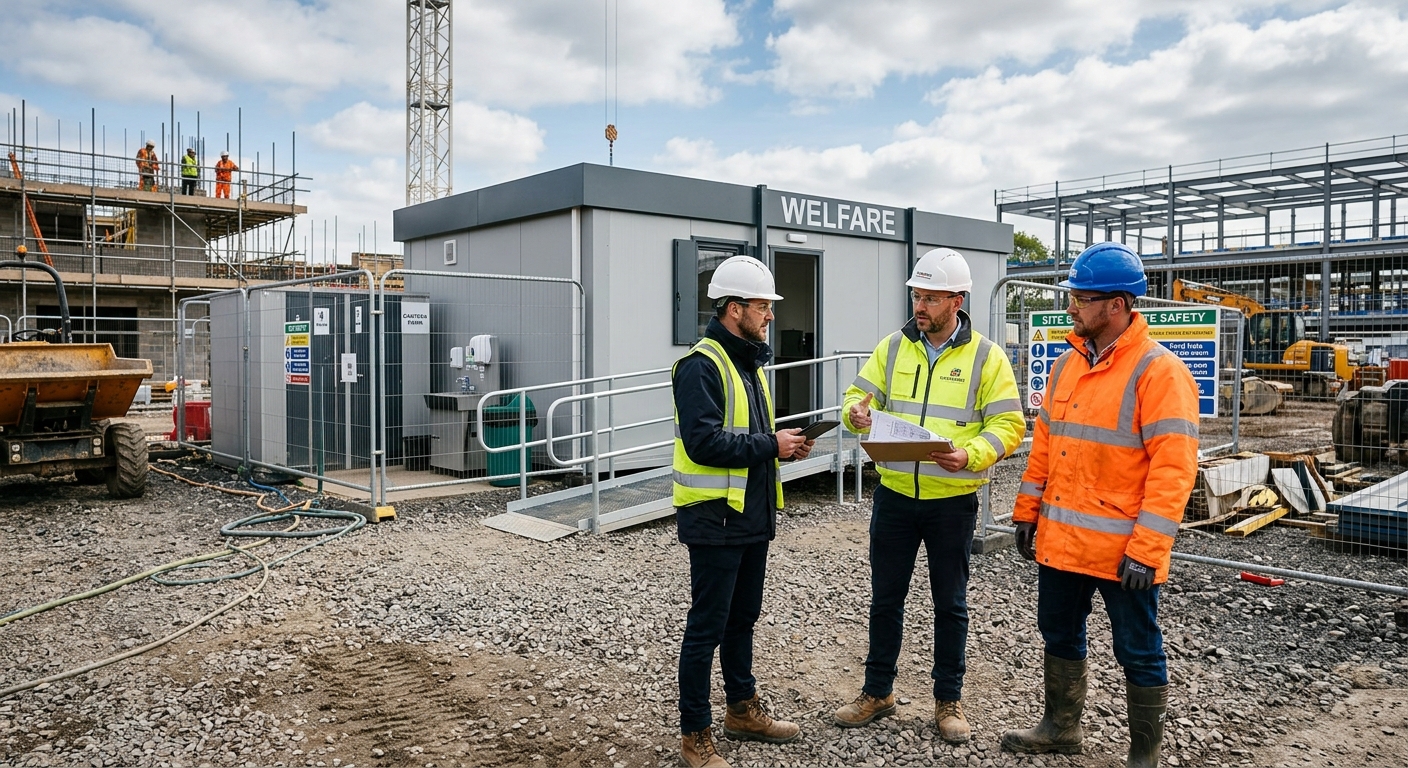
Construction site welfare is a shared responsibility under the Construction (Design and Management) Regulations 2015 (CDM 2015), but different dutyholders have different roles.
For commercial projects, the client must make sure suitable arrangements are in place for welfare facilities to be provided for the duration of the construction work.
Contractors must provide suitable welfare facilities for workers under their control.
Where a project involves more than one contractor, the principal contractor must ensure suitable welfare facilities are provided from the start and maintained throughout the construction phase.
This means responsibility cannot simply be passed down the subcontractor chain or left until workers arrive on site.
Welfare needs to be considered during project planning, provided when construction starts and maintained as the project develops.
For a practical list of the facilities that may be required, see Construction Site Welfare Checklist: What Facilities Must Be Provided?.
Who is responsible for construction site welfare under CDM 2015?
The answer depends partly on the project's dutyholder structure.
On a typical commercial project involving several contractors, responsibilities can broadly be understood as follows:
Client
↓
Makes suitable project arrangements and ensures suitable welfare facilities are provided for the duration of the construction work.
Principal contractor
↓
Ensures suitable welfare facilities are provided from the start and maintained throughout the construction phase.
Contractors
↓
Provide suitable welfare for workers under their control and cooperate with the project's arrangements.
These responsibilities overlap deliberately.
CDM 2015 is not structured around one organisation providing a portable toilet while everybody else ignores welfare.
The objective is to make sure suitable facilities are actually available to the people carrying out construction work.
What is the client's responsibility for welfare facilities?
Commercial clients have an important responsibility before and during construction.
HSE guidance states that commercial clients must make suitable arrangements for managing the project, including making sure suitable welfare facilities are provided for the duration of the construction work.
This means welfare should be considered when decisions are being made about:
- project programme;
- site setup;
- available space;
- budget;
- utilities;
- access;
- phasing; and
- contractor appointments.
Welfare should therefore be discussed before construction begins rather than treated as a problem for the site team to solve after mobilisation.
Does the client have to physically provide the welfare facilities?
Not necessarily.
There is an important distinction between ensuring welfare is provided and physically hiring, installing or cleaning the facilities.
The commercial client must make sure appropriate arrangements exist.
The practical provision may then be organised by:
- the principal contractor;
- the contractor;
- a welfare hire company;
- a facilities provider;
- the client through existing facilities; or
- another suitable arrangement.
A client cannot simply assume that welfare is "the contractor's problem" without making appropriate project arrangements.
What should be agreed before construction starts?
Welfare arrangements should be considered during planning and mobilisation.
Before construction begins, the project team should establish matters such as:
- expected workforce numbers;
- types of work;
- male and female workforce requirements;
- toilet provision;
- washing requirements;
- whether showers are required;
- drinking water;
- changing arrangements;
- drying facilities;
- rest and eating facilities;
- welfare location;
- water supply;
- drainage;
- electricity;
- cleaning;
- waste removal;
- servicing arrangements;
- who is responsible for maintenance; and
- how facilities will change as the workforce grows.
The practical objective is simple:
Welfare should be ready when workers arrive to start construction.
What is the principal contractor responsible for?
On a project involving more than one contractor, the principal contractor has a central role in managing the construction phase.
HSE guidance states that principal contractors must ensure suitable welfare facilities are provided from the start and maintained throughout the construction phase.
That means the principal contractor should have arrangements for monitoring whether welfare remains suitable.
This can include:
- checking facilities before work starts;
- monitoring cleanliness;
- arranging servicing;
- maintaining water supplies;
- replenishing consumables;
- dealing with defects;
- reviewing facilities as worker numbers increase;
- considering changing site conditions; and
- making sure facilities remain reasonably accessible.
The facilities need to remain suitable throughout the project.
Does the principal contractor have to pay for all welfare facilities?
CDM 2015 establishes health and safety duties. It does not provide a simple universal rule stating which party must ultimately bear every welfare cost under every construction contract.
Commercial arrangements about who hires or pays for welfare may be dealt with through:
- contracts;
- preliminaries;
- tender documents;
- project agreements;
- subcontract conditions; or
- other commercial arrangements.
For example, a disagreement about whether the principal contractor or a subcontractor should pay for additional facilities does not make it acceptable for workers to have inadequate welfare while the parties argue about the invoice.
The welfare requirement still needs to be met.
What are contractors responsible for?
Contractors have welfare responsibilities for workers under their control.
HSE guidance states that contractors must ensure suitable welfare facilities are provided from the start for workers under their control and maintained throughout their work.
On a multi-contractor project, contractors also need to cooperate with the principal contractor's arrangements.
A contractor should therefore consider:
- whether suitable welfare is available before its workers start;
- whether the facilities are appropriate for its activities;
- whether additional facilities are needed because of specific health risks;
- whether its workers can reasonably access the facilities;
- whether any deficiencies need to be raised with the principal contractor; and
- whether the contractor's work creates additional welfare requirements.
What are subcontractors responsible for?
Subcontractors carrying out construction work are contractors for the purposes of CDM where they employ, engage or control construction workers or manage construction work.
They therefore have contractor responsibilities.
On a project controlled by a principal contractor, a subcontractor will normally use the project welfare arrangements established for the site.
However, the subcontractor should still make sure suitable welfare is available for workers under its control.
This is particularly important where the subcontractor's work creates specific requirements.
For example, work involving:
- hazardous substances;
- heavy contamination;
- very dirty processes;
- remote work areas; or
- unusual working hours
The subcontractor should raise these requirements during planning rather than after the work has begun.
What about a project with only one contractor?
On a single-contractor project, there is no principal contractor.
The contractor carrying out the work has responsibility for providing suitable welfare for workers under its control.
The commercial client still has client duties, including making sure suitable welfare arrangements are in place for the duration of construction work.
The absence of a principal contractor does not reduce the welfare standard.
It simply changes the dutyholder structure.
For example:
Commercial client
↓
Makes suitable project arrangements and ensures welfare is provided.
Single contractor
↓
Provides and maintains suitable welfare for the workers carrying out the construction work.
What happens on domestic projects?
CDM 2015 treats domestic clients differently from commercial clients.
A domestic client is someone having construction work carried out on their own home, or the home of a family member, where the work is not being carried out as part of a business.
Domestic client duties normally pass to other dutyholders.
For a project involving one contractor, the contractor normally takes on the client duties as well as its own contractor duties.
Where more than one contractor is involved, the principal contractor normally takes on the client duties, unless alternative arrangements permitted by CDM 2015 have been made.
This does not mean welfare is optional on domestic projects.
Builders, electricians, plumbers, roofers and other construction workers still need suitable welfare.
Can contractors use the client's existing toilets?
Potentially, yes.
Existing facilities can sometimes form part of the construction welfare arrangements.
For example, workers might use suitable facilities in:
- an occupied building;
- an office;
- another part of the client's premises;
- a nearby café; or
- public facilities.
HSE guidance says there should be agreement allowing workers to use the facilities and they need to be available whenever workers are on site.
There also need to be suitable arrangements for matters such as:
- cleanliness;
- toilet paper;
- soap;
- towels or hand drying; and
- continued access.
An office toilet may be perfectly reasonable for clean refurbishment work involving a small number of workers.
It may be unsuitable for a large workforce carrying out extremely dirty or contaminated construction activities.
Can a client refuse workers access to existing welfare facilities?
Where existing client facilities form part of the agreed construction welfare arrangements, access needs to be reliable.
A project should not be planned on the assumption that workers can use the client's toilets and washing facilities only for access to be withdrawn once work starts.
If access cannot be guaranteed, alternative welfare arrangements may be required.
This is another reason welfare needs to be agreed during planning rather than handled informally after construction begins.
Who is responsible for cleaning construction site welfare facilities?
The project should establish who is responsible for cleaning and maintaining the facilities.
The practical task might be carried out by:
- a welfare hire provider;
- cleaning contractor;
- site labour;
- facilities team;
- principal contractor personnel; or
- another appointed service provider.
The principal contractor on a multi-contractor project needs to ensure suitable welfare remains available throughout the construction phase.
A toilet that was suitable when installed may become unsuitable if it is:
- dirty;
- overflowing;
- damaged;
- without toilet paper;
- without lighting;
- without water; or
- inadequately serviced.
How often should welfare facilities be cleaned?
There is no single cleaning frequency suitable for every project.
The frequency should reflect:
- workforce numbers;
- amount of use;
- weather;
- site conditions;
- type of facility;
- servicing schedule; and
- cleanliness observed during inspections.
The site team should monitor conditions and increase cleaning or servicing when required.
Waiting for facilities to become obviously unacceptable before taking action is poor welfare management.
Who is responsible for toilet servicing?
The practical servicing of portable toilets is often undertaken by the hire or specialist servicing company.
However, the project still needs to make sure the servicing arrangement is adequate.
This includes considering:
- number of toilets;
- number of workers;
- working hours;
- frequency of servicing;
- waste capacity;
- access for the servicing vehicle; and
- whether additional servicing is needed during peak periods.
Who is responsible for soap, toilet paper and hand drying?
The site welfare arrangements should assign responsibility for checking and replenishing consumables.
These can include:
- toilet paper;
- soap;
- paper towels;
- other hand-drying supplies;
- drinking cups where required; and
- cleaning materials.
A washbasin without soap or a toilet without toilet paper is not being properly maintained.
Routine welfare checks should include consumables.
Who is responsible for welfare inspections?
CDM 2015 does not require a particular job title to complete a form called a "welfare inspection".
The project needs effective arrangements for making sure facilities remain suitable.
The practical inspection may therefore be completed by someone such as:
- site manager;
- assistant site manager;
- site supervisor;
- health and safety adviser;
- facilities coordinator; or
- another appointed person.
- facilities are checked;
- deficiencies are identified;
- somebody is responsible for corrective action; and
- the problem is actually closed out.
See our Construction Site Welfare Checklist: What Facilities Must Be Provided? for a practical inspection checklist.
Should welfare inspections be recorded?
Keeping an appropriate record can be useful.
A welfare inspection record might show:
- project;
- inspection date;
- person completing the check;
- facilities inspected;
- defects found;
- photographs where appropriate;
- corrective action;
- responsible person;
- target date; and
- close-out status.
For example, if every inspection identifies that a particular toilet block runs out of consumables by Thursday afternoon, the project can change the replenishment schedule rather than recording the same defect every week.
Records can also support:
- project reviews;
- client audits;
- internal inspections;
- health and safety monitoring; and
- evidence of ongoing site management.
What happens if the workforce increases?
Welfare arrangements need to reflect the actual workforce.
A project may start with:
- six workers during mobilisation;
- increase to 40 during structural work; and
- reach 150 or more during peak fit-out.
The principal contractor should therefore monitor workforce levels and review welfare accordingly.
Changes might include:
- additional toilets;
- larger rest areas;
- additional changing space;
- more drying capacity;
- more frequent cleaning;
- more frequent toilet servicing;
- additional drinking water points; or
- satellite facilities in remote areas.
Who is responsible when the site layout changes?
The principal contractor's arrangements should account for the changing construction site.
A welfare compound that was easily accessible during groundworks may become difficult to reach once:
- buildings are enclosed;
- haul roads change;
- pedestrian routes move;
- exclusion zones are introduced;
- different work areas open; or
- the project expands geographically.
Workers should be able to access appropriate welfare without unreasonable difficulty.
Who is responsible for welfare in remote work areas?
Projects involving large or dispersed work areas require additional planning.
Examples include:
- highways;
- utilities;
- rail projects;
- pipelines;
- large infrastructure projects;
- agricultural locations; and
- remote maintenance work.
Possible solutions include:
- satellite welfare compounds;
- mobile welfare units;
- additional portable toilets;
- mobile washing facilities; or
- agreed use of suitable existing facilities.
Who is responsible for additional welfare needed because of hazardous work?
The welfare provision should reflect the nature of the construction work and its health risks.
Some activities may require enhanced washing or changing arrangements.
Examples might include work involving:
- cement;
- lead;
- contaminated land;
- sewage;
- micro-organisms;
- heavy dust contamination; or
- other hazardous substances.
- showers;
- larger washing facilities;
- separate clean and dirty areas;
- facilities for contaminated clothing;
- enhanced PPE storage; or
- additional hygiene controls.
Welfare is an important part of controlling occupational health risks.
What if a subcontractor says the welfare is inadequate?
The concern should be assessed rather than dismissed.
A subcontractor may identify a genuine problem affecting workers under its control.
Examples could include:
- insufficient toilets;
- no hot or warm washing water;
- facilities too far from the work area;
- inadequate changing arrangements;
- no suitable drying provision;
- poor cleanliness; or
- inadequate facilities for hazardous work.
Workers and contractors are often well placed to identify problems because they use the facilities every day.
What should a worker do if welfare is inadequate?
Workers should raise concerns through the site's established reporting arrangements.
Depending on the project, this could mean speaking to:
- their supervisor;
- employer;
- site manager;
- principal contractor;
- health and safety representative; or
- another appropriate person.
A suitable construction site induction should explain relevant site arrangements, including welfare and how concerns can be reported.
Can poor welfare stop construction work?
Inadequate welfare is a health and safety compliance issue.
The appropriate response depends on the circumstances and severity.
A minor issue such as a temporary shortage of paper towels may be capable of immediate correction.
More serious failures could require urgent action.
Examples might include:
- no usable toilets;
- no suitable washing facilities;
- no drinking water;
- serious contamination;
- sewage problems;
- facilities creating their own health risks; or
- welfare provision that is fundamentally inadequate for the workforce.
Is welfare only the principal contractor's responsibility?
No.
This is one of the most important points.
On a multi-contractor project, the principal contractor has a clear responsibility to ensure suitable welfare facilities are provided from the start and maintained throughout the construction phase.
But other dutyholders also have responsibilities.
The commercial client must make sure suitable welfare arrangements are provided for the duration of the work.
Contractors must provide suitable welfare for workers under their control.
The project therefore needs cooperation rather than responsibility being pushed from one party to another.
Welfare responsibility checklist
Before construction starts, ask:
Client
- Have suitable project management arrangements been made?
- Has welfare been considered during planning?
- Is sufficient time and resource available?
- Have welfare expectations been discussed with the contractor or principal contractor?
- Is suitable welfare expected to be available for the duration of construction?
Principal contractor
- Are welfare facilities ready before construction starts?
- Are they suitable for the expected workforce?
- Are cleaning arrangements established?
- Is toilet servicing arranged?
- Are consumables monitored?
- Are facilities inspected?
- Are defects recorded and corrected?
- Are worker numbers monitored?
- Are facilities reviewed as the site changes?
- Are contractor-specific welfare requirements coordinated?
Contractors and subcontractors
- Is suitable welfare available for workers under your control?
- Is it appropriate for your activities?
- Does your work create additional washing or hygiene requirements?
- Can your workers reasonably access the facilities?
- Have deficiencies been raised?
- Are you cooperating with the principal contractor's arrangements?
Ongoing management
- Have workforce numbers changed?
- Has the site layout changed?
- Are facilities still accessible?
- Is cleaning frequent enough?
- Is servicing adequate?
- Are hot water and drinking water available?
- Are soap, toilet paper and drying supplies stocked?
- Are rest areas clean?
- Are changing and drying arrangements still adequate?
- Have defects been closed out?
Common mistakes with welfare responsibilities
Assuming welfare is solely the client's problem
The client has important duties, but contractors and principal contractors also have specific responsibilities.
Assuming welfare is solely the principal contractor's problem
Contractors still need to make sure suitable welfare is available for workers under their control.
Leaving welfare until mobilisation
The arrangements should be planned before construction begins.
Arguing about who pays while facilities remain inadequate
Commercial arrangements should not result in workers being left without suitable welfare.
Providing facilities and never checking them again
Welfare needs to be maintained throughout the work.
Ignoring workforce growth
Facilities need to remain suitable as worker numbers change.
Assuming subcontractors need nothing additional
Some trades and activities may create specific washing, changing or hygiene requirements.
Having no clear responsibility for cleaning
If everybody assumes somebody else is doing it, welfare conditions can deteriorate quickly.
Recording defects without closing them
An inspection system is only useful if problems lead to corrective action.
How SiteSafe can help manage welfare responsibilities
Welfare responsibilities can involve several organisations and different members of the site team.
The practical problem is often not identifying that welfare is required.
It is maintaining visibility of:
what has been checked, what is wrong, who needs to act and whether the issue has been resolved.
SiteSafe can help project teams manage this process through digital forms, workforce information and wider construction compliance records.
Assign consistent welfare inspections
A construction welfare checklist can be managed digitally rather than through different paper forms on different projects.
Site teams can check areas such as:
- toilets;
- washing facilities;
- hot water;
- drinking water;
- changing facilities;
- drying arrangements;
- rest facilities;
- cleaning;
- heating;
- consumables; and
- general condition.
Create a timestamped inspection record
Digital welfare inspections can form part of the project's compliance record.
That provides evidence of:
- when the check took place;
- what was inspected;
- what issues were identified; and
- the condition recorded at the time.
Track problems rather than relying on memory
The value of an inspection is in what happens next.
If a check identifies:
No hot water
Toilet requires servicing
Soap needs replenishing
or
Additional facilities required because workforce has increased
the issue needs to reach the person who can resolve it.
A digital process can make deficiencies more visible than relying on handwritten notes or verbal conversations.
Compare welfare provision with workforce levels
Welfare suitability is closely linked to the number of people using the facilities.
SiteSafe's QR site check-in supports workforce attendance records.
This can help site management understand when workforce numbers are increasing and welfare arrangements may need to be reviewed.
For example:
Project mobilisation - 12 workers
↓
Peak construction - 85 workers
↓
Attendance information shows workforce growth
↓
Welfare provision reviewed
↓
Additional toilets and rest capacity arranged
The objective is to recognise the change before existing facilities become inadequate.
Keep welfare within the wider CDM picture
Welfare is one part of construction-phase health and safety management.
SiteSafe's CDM compliance tools can help project teams manage wider CDM requirements alongside welfare monitoring.
SiteSafe also supports:
- site inductions;
- toolbox talks;
- RAMS;
- permits to work;
- digital forms; and
- workforce attendance.
Make responsibility visible
Digital records do not change the legal responsibilities under CDM 2015.
They can, however, make the management process clearer.
A useful workflow is:
Welfare inspection completed
↓
Problem identified
↓
Corrective action required
↓
Responsible person deals with the issue
↓
Condition rechecked
↓
Compliance record retained
That gives project teams a more usable process than discovering during an audit that everybody thought somebody else was responsible.
Explore SiteSafe digital forms to see how construction inspections and compliance checks can be managed digitally.
Welfare is a shared responsibility, but duties must be clear
Construction welfare should not fall into a gap between the client, principal contractor and subcontractors.
On commercial projects, the client must make suitable project arrangements and ensure suitable welfare facilities are provided for the duration of construction work.
On multi-contractor projects, the principal contractor must ensure suitable welfare is provided from the start and maintained throughout the construction phase.
Contractors must provide suitable welfare for workers under their control.
The practical arrangements may involve several organisations, but the end result should be straightforward:
Workers have suitable toilets.
They can wash properly.
They have drinking water.
They have appropriate changing and drying facilities where required.
They have somewhere suitable to rest and eat.
And those facilities remain suitable throughout the work.
For the practical requirements behind those responsibilities, use our Construction Site Welfare Checklist: What Facilities Must Be Provided?.